How Much Does a New Roof Cost in Arkansas in 2026? A Homeowner's Guide
A new roof is one of the biggest checks most homeowners will ever write. It's also one of the most confusing — quotes can swing by tens of thousands of dollars depending on who you call, and it's not always clear why.
Here's the short answer, then the full breakdown of what actually drives the price.
The Short Answer
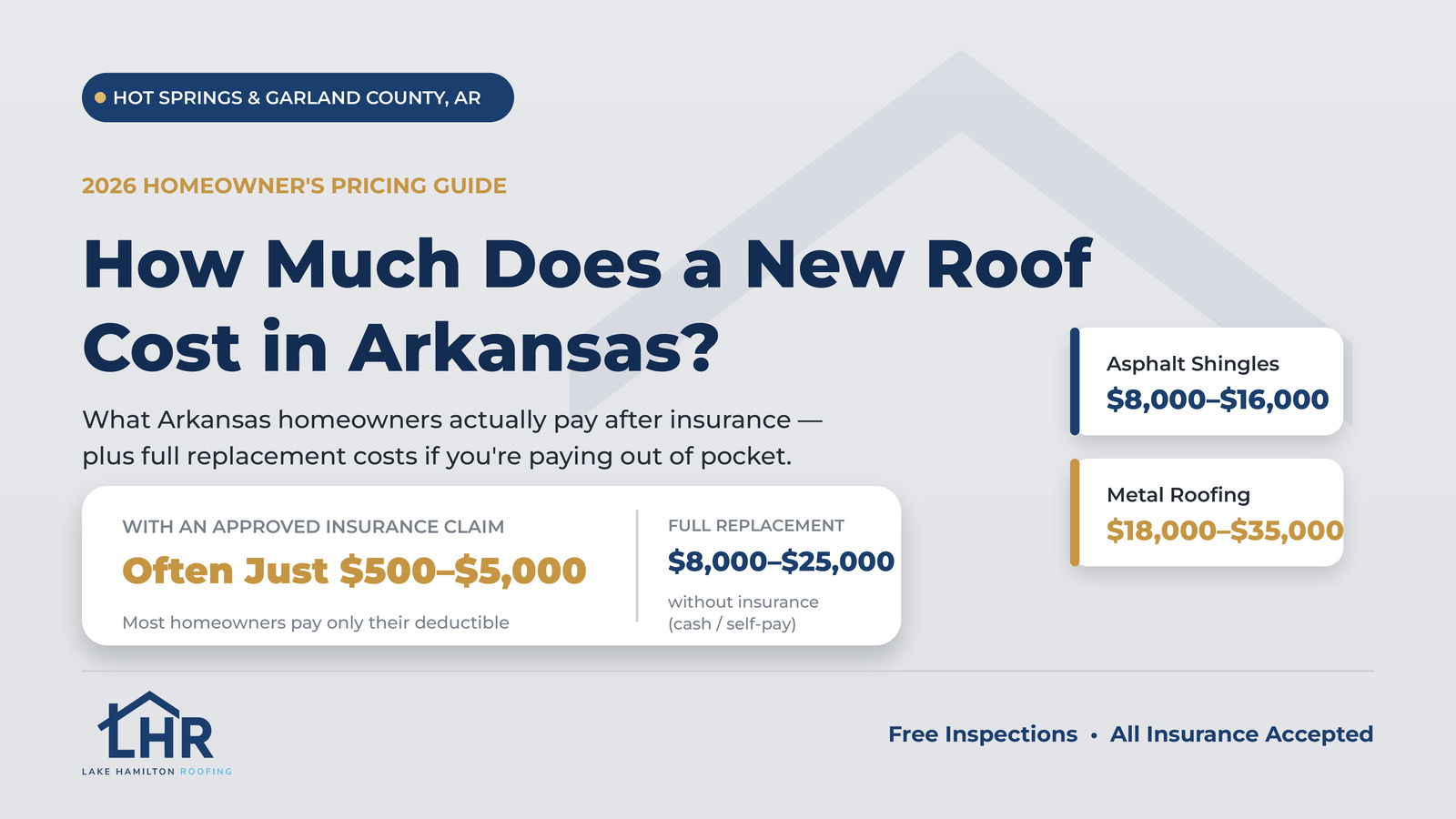
With an approved insurance claim, most Lake Hamilton Roofing homeowners pay only their deductible — typically $500 to $5,000 — not the full cost of the roof. That's the number that matters for most homeowners in Hot Springs and Garland County, because most "I need a new roof" situations here trace back to hail or wind damage insurance is designed to cover.
If you're paying entirely out of pocket — no insurance claim involved — a full roof replacement in Arkansas typically runs $8,000 to $25,000, with most mid-size homes landing in the $9,000 to $16,000 range for standard architectural shingles.
The gap between those two numbers is exactly why a free inspection is worth doing before you assume you're on the hook for the bigger figure.
What Actually Drives the Price
- Roof size. Roofers price by the "square" — a 10-foot by 10-foot section, or 100 square feet. A 2,000-square-foot roof is roughly 20 squares. Size is the single biggest factor in your total cost, full stop.
- Material. This is where the range really opens up:
- 3-tab asphalt shingles $6,500 – $10,000 15–20 years
- Architectural (dimensional) shingles $8,000 – $16,000 25–30 years
- Premium designer shingles $12,000 – $22,000 Up to 50 years
- Exposed-fastener metal $10,000 – $18,000 30–40 years
- Standing seam metal $18,000 – $35,000+ 40–60+ years
- Architectural shingles from brands like GAF, Owens Corning, and CertainTeed make up the large majority of Arkansas roof replacements. They hold up well against our wind and hail, carry solid warranties, and hit a comfortable price point for most homeowners.
- Pitch and complexity. A steep roof, or one with a lot of valleys, hips, dormers, and chimneys, takes longer to work on safely and uses more material for flashing and waste. Complex roofs can run up to 30% more than a simple, low-slope roof of the same size.
- Tear-off and disposal. Removing your old roof typically adds $1 to $3 per square foot. If you've already got two or three layers of shingles up there, expect that number to land on the higher end.
- Labor. Arkansas labor rates run lower than most of the country — our region's construction costs sit well below the national average. That's part of why Arkansas homeowners often get more roof for their dollar compared to other states.
- Permits. Most Arkansas municipalities require a permit for a full roof replacement. Fees are modest — usually under $200 — and a good contractor handles the paperwork for you.
A Real-World Example
Take a typical 2,000-square-foot single-story home in Garland County with a moderate pitch and architectural shingles:
Tear-off and disposal: ~$1,500
Materials (shingles, underlayment, flashing, ridge vent): ~$6,000
Labor and installation: ~$4,000
Permit: ~$150
Total: roughly $11,500–$12,500 — right in the middle of what most homeowners around here actually pay.
The Insurance Factor
Here's what changes the math entirely: if your roof damage came from a covered event — hail, high wind, a fallen limb — your homeowner's insurance policy may pay for some or all of the replacement. Your out-of-pocket cost typically comes down to your deductible, most often $500 to $5,000 depending on your policy.
Hot Springs and Garland County see enough hail and wind activity most years that a lot of "I need a new roof" situations are actually "insurance owes me a new roof" situations. Homeowners just don't always know it, because storm damage often isn't visible from the ground.
That's the whole reason a professional inspection matters before you assume you're paying full price out of pocket.
The Process, Start to Finish
- Free inspection. A trained eye gets on the roof, checks the field shingles, flashing, and accessories, and documents anything a homeowner wouldn't catch from the driveway.
- Honest report. You get a clear rundown — what's damaged, what's just wear, and what your real options are. No pressure, no guesswork.
- Insurance claim, if applicable. If the damage is storm-related, we help you file and meet the adjuster on-site so nothing gets missed or underpaid.
- Written estimate. A detailed quote — material, labor, tear-off, everything — so there are no surprises on install day.
- Material order and scheduling. Once approved, materials are ordered and a firm install date is set, usually within a couple of weeks depending on the season.
- Install day. Most residential roofs are torn off and replaced in a single day. Larger or more complex roofs may take two.
- Final walkthrough and cleanup. A full property sweep for nails and debris, plus a final inspection before we call the job done.
- Budgeting for a New Roof
If you're paying out of pocket rather than through insurance, a few things help make the cost more manageable:
Get a written, itemized quote — not just a total number — so you know exactly what you're paying for.
Ask about flexible payment options. Most reputable roofing companies, including ours, offer payment plans for homeowners covering the cost themselves.
Time it right. Roofing demand (and pricing) tends to ease outside of peak storm-repair season.
Don't skip the inspection just because you assume it's not storm-related. It costs nothing to find out, and it might save you from paying full price for something insurance would have covered.
What to Watch Out For
Bids that are dramatically lower than everyone else's. That usually means shortcuts on materials, underlayment, or proper flashing — corners that show up as leaks two years later.
Contractors who want full payment up front. A deposit is normal. The full balance before the job is done is not.
No local address or licensing. Storm season brings traveling crews from out of state. If something goes wrong under warranty, you want a company that's still around — and easy to find — next year.
Bottom Line
Most Lake Hamilton Roofing homeowners with an approved claim pay $500 to $5,000 — their deductible, not the full roof price. Without insurance, a full replacement typically runs $8,000 to $25,000 depending on size and material. Before you budget for either number, it's worth finding out which situation you're actually in — because a lot of Hot Springs roofs that "need replacing" are roofs insurance owes.
Not sure which situation you're in? Schedule a free, no-obligation roof inspection and get a straight answer either way.